PPG Maturity Model – Busting the Myth
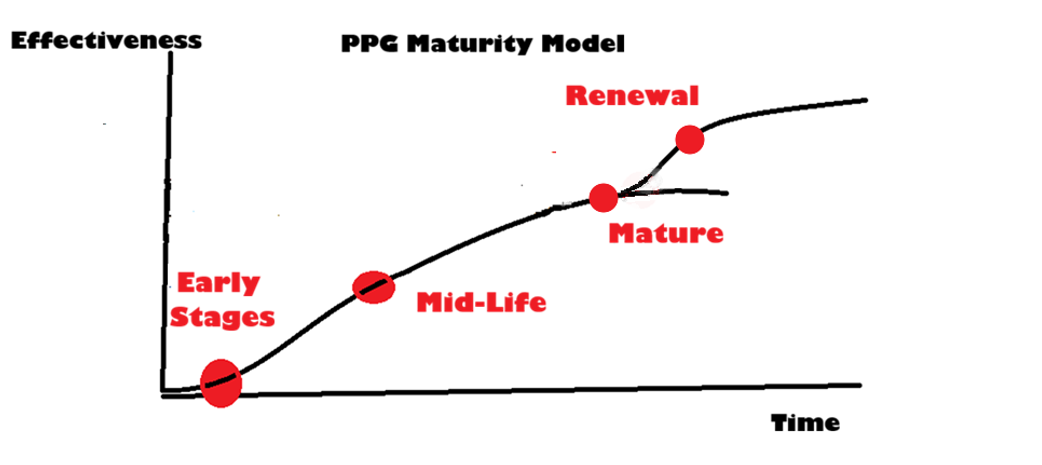
“All PPGs are different”- that has been the myth for many years; and to an extent it’s accurate ………. But it would be more inciteful to say that all PPGs are at some stage within an overall Maturity Model. And here is that model:
We can give some explanation:
• Non Existent – not shown on the chart as their level of maturity is zero!
• Early Stages - the PPG hasn't been set up for long and is just finding its feet (typically 0-9 months)
• Early Growth - getting established and trying lots of different ways to engage with patients and challenging issues like diversity and wellbeing (typically 1-3 years)
• Early Mature - functioning well and achieving some patient engagement
• Renewal - typically something has happened to disrupt the PPG - the resignation of key PPG Members or a change of Practice Manager for example. This can happen at any time!
• Mature - fully functioning, well engaged PPG (typically 3 years plus}
And PPGs will face different challenges at each of these levels. From our buddying experience (qv) we can typify them as follows:
• Non Existent – there is a laser focus on identifying people that could form part of the “to be formed” PPG. That involves finding a core team and then establishing a patient chair.
• Early Stages – the typical challenges facing this PPG are both operational and internal:
o Clarity on the purpose of the PPG
o Developing a Terms of Reference
o Agreeing ways of working
o Developing the patient role
o Run an initial survey
• Early Growth – this is the point that the PPG moves from “What are we going to do?” to “How do we do it?” The critical point at this stage is for the PPG to create a strong level of trust between the PPG and the Practice. Issues that are generally addressed at this point are
o Access to patients and GDPR
o Content development and getting it out
o Messaging
o Social Media
o Building PPG membership
o Invited membership versus universal membership
o Reaching under-represented communities
o PPG members taking on specific roles
o Support for carers
• Early Mature – the key differentiator here is that the PPG tends to move from communications to engagement – communications is one-way whilst engagement is two-way. The following are typically challenging at this point:
o Creating events
o Patient wellbeing (the NHS should be a health service, not a sickness service!
o Patient experience of minority groups – this could include ethnicity, people for whom English is a second language, learning disability, etc.
o Sustainability – it’s at this point that the initial enthusiasm starts to wane!
o Identifying systemic issues – it is critical to be able to assess whether an issue is a one off or endemic!
o Getting engaged in new ways of working – and the impact on patients
o Digital exclusion and NHS App inclusion
• Mature – by this stage the PPG will be doing most things right and the challenge is simply1
o Governance
o Patient behaviour
o Shadow PPG – to fully engage with minorities
o Mobilising new ways of working
o Deep patient engagement
o Respected and valued by practice
• Renewal: there are two scenarios
o Change of Practice Manager/ Lead GP – the ideal way is to have a meeting with the new lead person and discuss “this is what we were planning to do over the next twelve months, but we’re open to discuss any changes to our plans.
o Change of chair – get a new governance structure in place and focus on
What went well and we want to keep?
What didn’t go so well and what do we need to change?
As a result of these two, what are our plans going forward?
The maturity model is a great way to establish where a PPG is today and what it needs to do moving forward.
Alan Bellinger
30th April 2026