Health & Care Provision in Hertfordshire
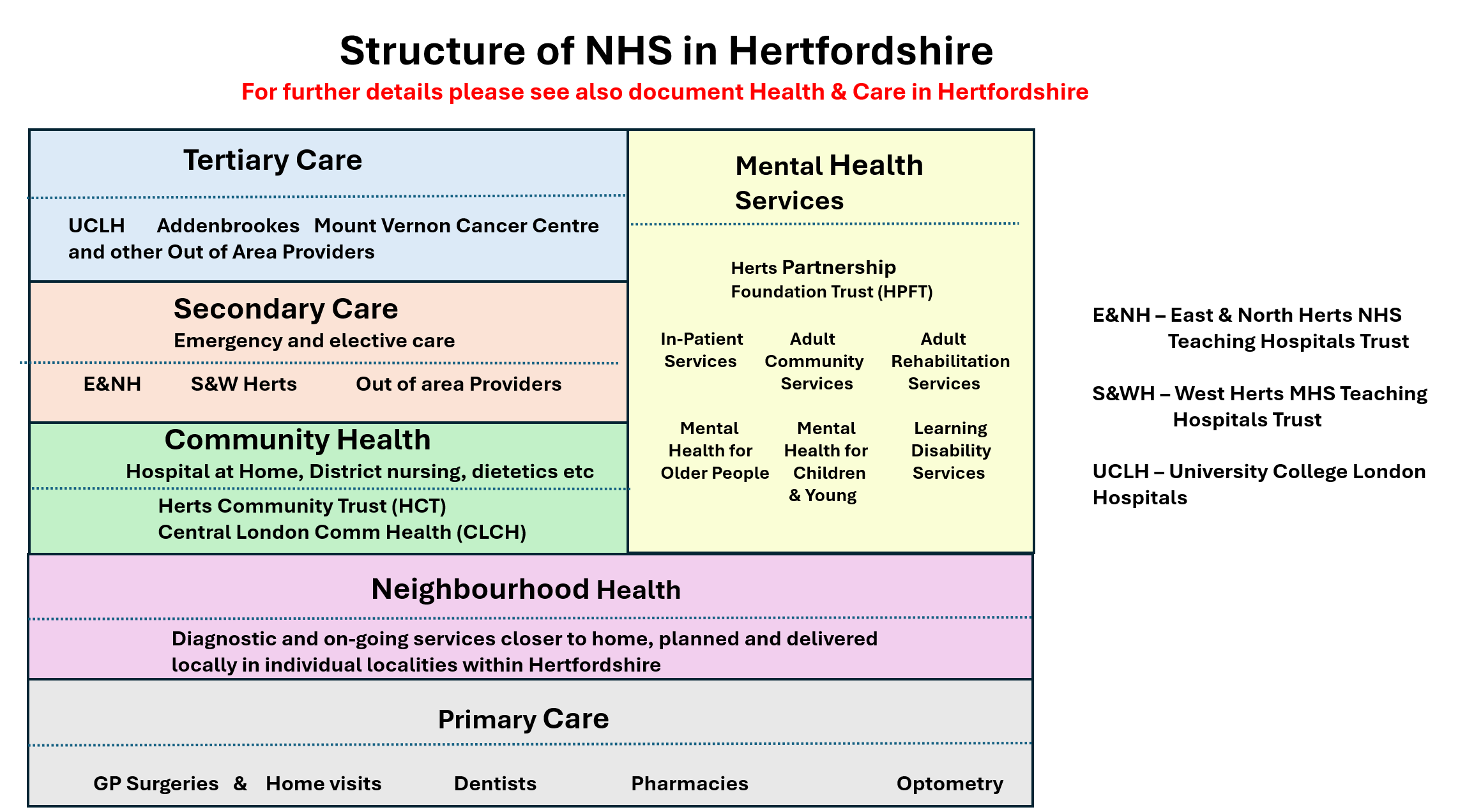
To be read in conjunction with the graphic “Structure of NHS provision in Hertfordshire” ( see below)
Introduction
Up until very recently, and until the publication of the Government’s 10 Year Health Plan the healthcare system was a relatively straightforward up and down system. However, things are changing, and this article is aimed at trying to explain the system as it currently stands and how it may look in the future.
Core Structure of Management and Governance
The national system is decentralised, with the NHS in England operating separately from NHS systems in Scotland, Wales, and Northern Ireland. In England, the structure is organised as follows:
The Department of Health and Social Care (DHSC): Sets the government's overall health policies and funding.
Integrated Care Systems (ICSs): these are regional partnerships that bring together NHS organisations, local councils, and care providers to plan and fund health services for their specific populations.
Integrated Care Board (ICBs) Integrated Care Boards (ICBs) are statutory NHS organizations responsible for planning and funding health services for local populations. They distribute NHS budgets, contract local healthcare providers (like GPs and hospitals), and work alongside local authorities to improve overall community health and address inequalities
The NHS Hertfordshire and West Essex Integrated Care Board (ICB) was officially dissolved on March 31, 2026. Since April 1, 2026, healthcare planning and
commissioning for the region has been split and merged into two larger “cluster” ICB’s i.e. for
Hertfordshire Residents: Hertfordshire has been merged into the new NHS Central East ICB, covering Bedfordshire, Luton, Milton Keynes, Hertfordshire, Cambridgeshire, and Peterborough.
West Essex Residents: West Essex has been moved to the new Essex ICB, operating alongside Mid and South Essex.
Primary Care Networks (PCN’s)
In Hertfordshire, responsibility for healthcare provision is largely being devolved to Primary Care Networks (PCNs) - groups of GP practices working closely together with other healthcare staff and organisations to provide more joined up care to local communities. PCNs are led by clinical directors who are medically qualified. They usually serve communities of 30,000 to 50,000 people
In Hertfordshire the current PCN structure, which largely follows the previous Health Care Partnership organisational structures, includes:
East and North Hertfordshire: PCN’s cover Broxbourne, East Herts, North Herts, Stevenage, and Welwyn Hatfield.
South and West Hertfordshire PCN’s include Dacorum, Hertsmere, St Albans, Three Rivers, and Watford.
Specialist Mental Health: The Mental Health, Learning Disability, and Neurodiversity (MHLDN) Partnership focuses on providing integrated, county-wide wellbeing support.
NHS Trusts: Manage hospitals, mental health services, and community health centres.
And - If you need to access healthcare – the system is currently split into a number of levels of Care…….
Primary Care: This is typically your first point of contact. It includes GPs (General Practitioners), dentists, opticians, and local pharmacies. You must register with a local GP practice to access non-emergency medical care.
Urgent & Emergency Care: For severe or life-threatening emergencies, you may go to an A&E (Accident & Emergency) department or call 999.
These services are usually provided in Acute Hospitals
For urgent but non-life-threatening issues, you should can call 111 for their advice or visit an NHS Walk-in Centre.
Secondary Care: If you need specialised preplanned “Elective” care whether medical care or surgery, your GP will refer you to a hospital specialist. This is known as secondary care and again normally provided by your local Acute Hospital Trust
Tertiary Care - sometimes termed Centres of Excellence providehighly specialised medical care. These centres are often regional services and patients are referred from several Acute Hospitals across their catchment area. This is usually because they require very advanced equipment, complex treatments, and specialised medical experts, for example Cancer Centres providing Radiotherapy or Chemotherapy, Cardiothoracic Centres providing very specialist Heart tests and procedures or Neurosurgery: Complex brain and spinal cord surgeries.
Quaternary Care: Extremely rare, often experimental care for unusual conditions, and provided at a national level
Further reading
https://www.kingsfund.org.uk/insight-and-analysis/animations/how-does-nhs-england-work
However, things are changing at the moment (June 2026)
In the 10 Year Health Plan for England, the government promised to “give power to people”
In order to achieve this, they recognised a need to end people being passed from pillar to post in a fragmented and, at times, chaotic system, and the aim is to make local health services meaningfully accountable to local residents and service users.
The Ministerial foreword to the 10 Year plan puts it like this
“Neighbourhood health will only work as a joint endeavour between the NHS and local authorities, alongside wider partners. We expect this to be a truly collaborative effort between all partners, combining the NHS’s responsibility for our health services with local authorities’ responsibility for adult and children’s social care services and public health. This will foster a true partnership for the benefit of all citizens to ensure we achieve the left shift from hospital to community, and sickness to prevention.
Neighbourhood health puts the person at the centre of how we deliver their health and care by organising services so they can work together to serve a defined population. This includes the services that people rely on close to home and on the high street, such as GPs, pharmacies, dentists and community services and, where appropriate, urgent care, diagnostics and outpatients. This also includes local authority-commissioned services, such as adult and children’s social care and public health services
Organise services around the person with more convenient, personalised and joined-up care
We aim to orientate services around a person’s needs, rather than organisational convenience. A strong digital approach will be critical to this. This includes:
improving access to care (by phone, online or in person)
moving more outpatient care from hospitals into neighbourhoods
improving continuity of care for those with longer-term needs
more effectively co-ordinating services for those with the most complex needs, for example, those at end of life
Reduce pressure on more acute services - including hospitals and care homes
We aim to do this by:
using effective neighbourhood working to decrease avoidable hospital admissions or attendances and facilitate timely discharge
reducing the de-conditioning that happens to many people when they spend time in hospital
reducing avoidable care home admissions
ensuring acute services are focused on those who need them most
Cut waste and duplication -
We aim to do this by:
integrating services across health, local government and wider partners
making full use of digital opportunities
ensuring the NHS is more sustainable
to Help the NHS deliver against core targets”
Health and Wellbeing in Hertfordshire
Hertfordshire County Council is responsible for providing a county-wide Health and Wellbeing Strategy - a statutory requirement for local areas
It sets out the vision and strategic priorities for improving health and wellbeing and reducing health inequalities in the County.
It explains a clear ambition with a focus on the big issues in the local population that can only be tackled through collective action. It’s a commitment to continuously improve the health and wellbeing of Hertfordshire’s residents.
The strategy is owned by all partners through the leadership of Hertfordshire’s Health and Wellbeing Board (HWB), a collaborative multi-agency partnership bringing together senior leaders from the County Council (Public Health, Adult Social Care and Children’s Services), the NHS (Integrated Care Board, Acute, Community, Mental Health NHS Trusts etc), elected representatives from the County, District and Borough councils, Voluntary, Community, Faith and Social Enterprise sector (VCFSE), and the Police and Crime Commissioner
So, the aim is to move towards Neighbourhood Health - a community-focused model of care that moves some healthcare services out of traditional hospital settings and directly into local communities. It hopes to bring together GPs, nurses, social care workers, and community volunteers, as well as some services currently delivered by Acute Hospitals into single hubs to provide “joined-up support closer to where people live”.
This approach—central to the current 10 Year Health Plan and the NHS—focuses on three main shifts in the approach to service provision:
Hospital to community: Moving things like routine diagnostics (Blood tests, Radiology etc) rehabilitation (Physiotherapy, Occupational Therapy etc) and some post-operative care into the community, provided by local Neighbourhood Health Centres.
Analogue to digital: Expanding the NHS App into a comprehensive "front door" for the entire NHS and creating a single Electronic patient record (EPR).
Treatment to prevention: Using proactive care and community outreach to detect illnesses early and help residents manage long-term conditions before crises.
Neighbourhood Health Hubs/Centres: The actual terminology is a bit “fluid” at the moment as people are working hard to determine the best ways to fulfil the government’s strategy in their areas.
Currently (June 2026) it is expected that there will be up to 250 of these new hubs across England, some centred around towns and cities and some encompassing more rural areas, but all designed specifically to tackle frailty and provide localised therapies and specialist support.
You can explore more about how this is being rolled out by checking out the GOV.UK Neighbourhood Health Framework or the King's Fund Guide on Neighbourhood Health.